

Park · Chicago · ⭐ 9.3/10 · 4218 reviews · updated: 2026-08-04 16:02:05
Address: 1200-5700 S DuSable Lake Shore Dr, Chicago, IL 60615, United States
Burnham Park — six miles of shoreline that Chicago built for itself
A narrow green ribbon runs for roughly six miles between Grant Park and Jackson Park, holding beaches, harbors, restored prairie, a skate park and one of the finest pieces of landscape design on the Great Lakes. Almost every acre of it is manufactured. There was no shoreline here to speak of: the park was filled out into Lake Michigan through the 1920s and 1930s, deliberately, to realize the continuous south lakefront that Daniel Burnham had drawn in his Plan of Chicago. It took his name in 1927, and it remains the stretch where the city’s waterfront stops being an accident of geography and becomes an argument about what a public shore should be.
Highlights
- Promontory Point — a 40-acre artificial peninsula landscaped by Alfred Caldwell in the Prairie Style, with a raised central meadow, groves of mature trees, native planting and a stepped revetment of large limestone blocks running down to the water.
- The Point field house — a rugged limestone building of 1937 by Park District architect Emanuel Buchsbaum, put up by skilled Works Progress Administration craftsmen and still the anchor of the peninsula.
- The council rings — circular stone benches Caldwell specified from the start in the tradition of Jens Jensen; his superiors substituted cheaper hexagonal concrete, and the stone rings were finally built in 1989 under Caldwell’s own supervision.
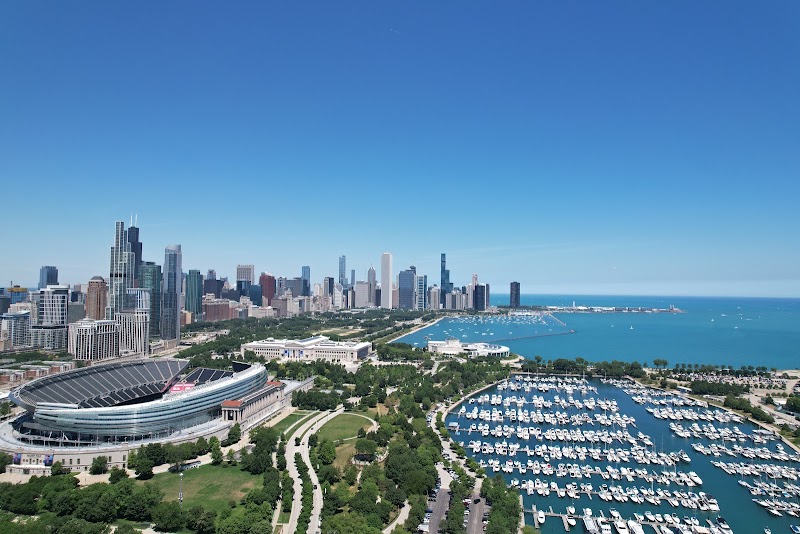
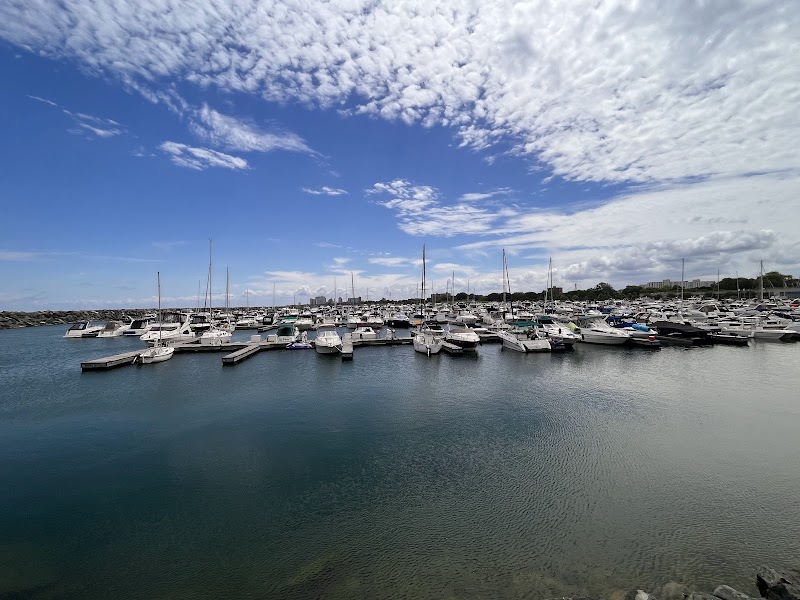
- 31st Street Beach — a broad swimming beach with a modern beach house, paired with a harbor opened in 2012 that holds about 1,000 floating slips, a boat ramp and a harbor store.
- The Burnham Wildlife Corridor — roughly 100 acres of restored prairie, savanna and woodland strung along the middle of the park, among the largest natural areas anywhere on the Chicago lakefront.
- The Lakefront Trail — six of its eighteen miles run through this park, with cyclists and pedestrians on fully separated paths since a rebuild completed in December 2018.
What you’ll find
Burnham Park is long rather than wide, so it is best understood not as a place you enter but as a sequence of destinations strung along the water. You choose a section, and the section decides what kind of day you have.
- Several swimming beaches along the shore, including 31st Street Beach and Oakwood Beach further south, all lifeguarded in season.
- A concrete skate park beside the harbor, one of the busiest in the city and in use from early spring.
- Fishing piers, breakwaters and open lake overlooks that stay in use year-round, including through winter.
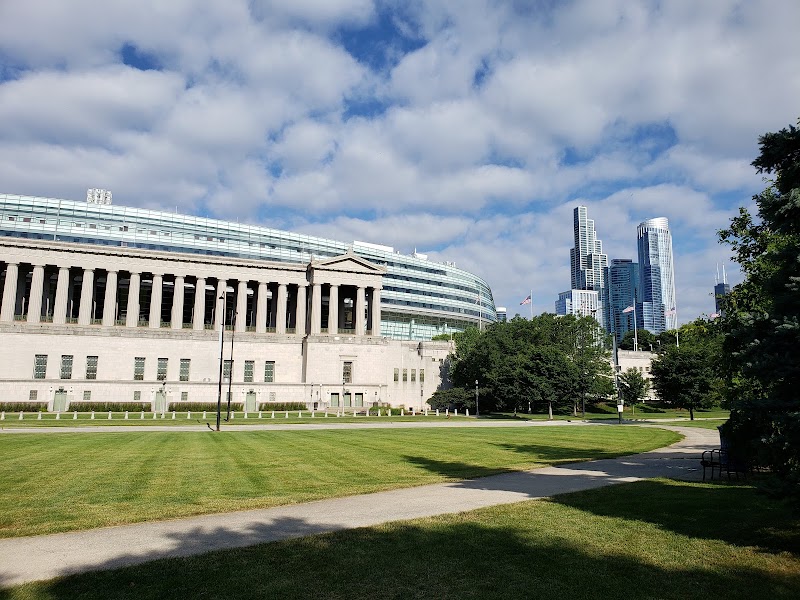
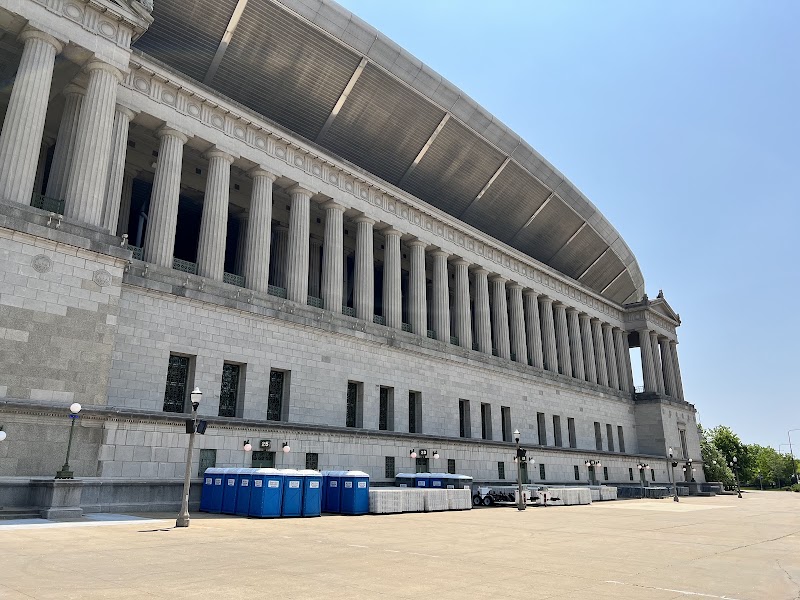
- Soldier Field, by Holabird & Roche and completed in the mid-1920s, and McCormick Place, opened in 1960, both standing within the park’s northern boundary.
- Northerly Island at the northern end — the only offshore landform from Burnham’s proposed island chain ever actually built.
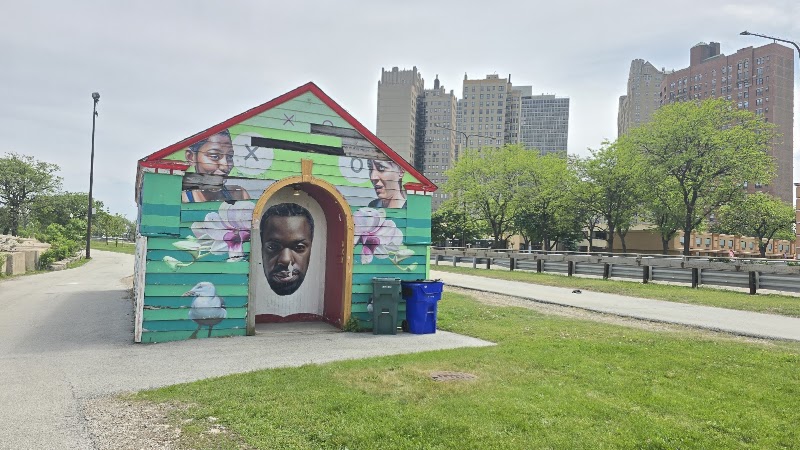
- Meadows, playfields, picnic groves and public art scattered between the built landmarks.
Things to do — and who it’s for
- Runners and cyclists — the longest uninterrupted lakefront stretch in the city, with the downtown skyline in view for most of it and separated paths keeping bikes and feet apart.
- Swimmers and sunbathers — the southern beaches are far less crowded than the downtown ones, with more room per towel on any summer weekend.
- Architecture travelers — Promontory Point is a rare surviving Prairie Style public landscape, and it only reads properly on foot, walked slowly.
- Birders and naturalists — the wildlife corridor and the restored island prairie are working migration stopovers, not decorative planting.
- Skaters — the concrete park draws riders from across the South Side and beyond, and it runs long into the evening in summer.
- Photographers — the view back toward downtown from the Point, across open water, is the best skyline shot in Chicago.
Getting there & practical
The park threads past the Near South Side, Douglas, Oakland, Kenwood and Hyde Park neighborhoods, so there is no single entrance and no main gate — you pick the section you want and arrive beside it. Metra Electric District trains stop at 18th Street, McCormick Place, 27th Street, 47th Street, 51st/53rd Street and 55th-56th-57th Street, each landing you within walking distance of a different stretch of shore, and the Green Line ‘L’ serves the 35th-Bronzeville-IIT station a short distance west. Entry to the park, the Lakefront Trail, the natural areas and the beaches is free. Boat slips at the harbor, organized sport and events at the stadium and the convention center are separate and paid. The lakefront is open daily from early morning until late evening, and beaches are lifeguarded only in the summer season. One section takes about an hour on foot; riding the full length and back is a half-day outing. Bring water in summer — the park is exposed, with little shade between the groves.
When to visit
Summer is the obvious season: swimming, harbor traffic, the skate park at full tilt and the trail at its busiest, which is why it is best ridden before mid-morning. Autumn is arguably better — the prairie plantings turn gold, migrating birds drop into the corridor and onto the island, the crowds thin out, and the lake holds its warmth into September. Winter strips the park back to stone and ice, and the limestone terraces at the Point with a frozen lake behind them are among the great cold-weather sights of the city; dress for wind, because there is nothing between you and the water. Spring arrives late on this shore and stays raw into April, but the restored prairies green up in late April and May, and the trail comes back to life before the beaches do.
Good to know
Daniel Hudson Burnham (1846-1912) was the architect and planner who served as chief of construction for the 1893 World’s Columbian Exposition and then, with Edward H. Bennett, authored the Plan of Chicago in 1909, illustrated by Jules Guerin. That plan proposed a continuous park along the south lakefront with a chain of artificial islands, a linear boating harbor, beaches, meadows and playfields — a public shore instead of an industrial one. Landfill work began at the north end in 1919, and in 1920 voters approved a $20 million bond for the south shore development; a breakwater was extended along the shoreline between 1924 and 1926, and by 1925 Northerly Island was complete, the only island of the proposed chain ever built. The park took Burnham’s name in 1927. The Century of Progress international exposition was held on this new ground in 1933 and 1934, and left behind the Balbo Monument, an ancient Roman column brought from Ostia Antica and presented by the Italian government in 1933. Promontory Point followed: designed in 1937 by Alfred Caldwell — later a professor at the Illinois Institute of Technology and an heir to the Prairie School tradition of Jens Jensen — it was built with Works Progress Administration labor and opened to the public that autumn. Caldwell’s four stone council rings were rejected as too costly and replaced with hexagonal concrete benches, and he lived to oversee the stone rings finally being installed in 1989. The Point was designated a Chicago Landmark in April 2023. At the north end, Northerly Island served as Meigs Field until the runway was destroyed on the mayor’s order in 2003; a music pavilion opened there in 2007, and habitat restoration of the island’s southern 40 acres, planned by Studio Gang with the US Army Corps of Engineers and JJR, began in 2012 and opened to the public in September 2015 as prairie, savanna and wetland. The Lakefront Trail rebuild that separated cyclists from pedestrians along all eighteen miles was completed in December 2018, funded by a $12 million gift from Kenneth C. Griffin, with a 12-foot asphalt bike path inland and a 20-foot pedestrian path nearer the water.
Visitor tips
- Ride the trail northbound in the morning and southbound in the evening — the light stays behind you and the skyline stays ahead, which matters more here than on any other stretch of the lakefront.
- Wear proper shoes at the Point. The limestone steps are uneven, and they turn genuinely dangerous when spray freezes on them in winter.
- Pick your entrance by train station rather than driving the length of the park. Parking is thin, the park is six miles long, and every station lands you at a different character of shore.
Questions & answers
How long is Burnham Park? Roughly six miles along the shore, running between Grant Park in the north and Jackson Park in the south, on close to 600 acres of made land.
Who was the park named after? Daniel Burnham, chief of construction for the 1893 fairgrounds and co-author of the 1909 Plan of Chicago, which proposed this very shoreline. The park took his name in 1927, fifteen years after his death.
What makes Promontory Point special? It is Alfred Caldwell’s 1937 Prairie Style landscape on a manmade peninsula, with a stepped limestone edge, a raised meadow, a WPA-built field house and stone council rings installed in 1989. It became a Chicago Landmark in April 2023.
Is this natural shoreline? No. Nearly all of it is landfill pushed out into Lake Michigan from 1919 through the 1930s, following the Burnham plan, including the whole of Northerly Island.
Can you swim in Burnham Park? Yes, at several lifeguarded beaches through the summer, including 31st Street Beach and Oakwood Beach; the southern beaches are markedly quieter than those downtown.
Is there a charge to enter? No. The park, the Lakefront Trail, the natural areas and the beaches are all free. Boat slips at the harbor and events at the stadium and convention center are paid separately.
Photos
Show 1 more photos
Visitor reviews
Reviews last updated: 2026-08-04 16:02:05
Data is refreshed monthly. Sources: chicagoname.com and editorial picks based on reviews.
What impressed me most was how quiet it was on the lakefront in the morning, even with people walking, running and cycling. I came for a walk along the water and ended up staying longer, because the paths were clean, the…
A wonderful open-air area on the lakefront. It has great views, nice amenities and a beach. Highly recommend.
Such a nice and peaceful place to visit, with some of the cleanest water on Chicago's lakefront. It's definitely one of the best places to enjoy the city's natural beauty, and what makes it even better is how accessible…
I really enjoyed visiting this lakefront spot after so many years! The park is small but wonderful, located on the South Side and kept clean. Early on it's quiet and perfect for running, with great trails and a stunning…
It's a great place, but keep in mind that a new parking feature has appeared here. There's a gate now, and on entry you need to scan a QR code and register with a credit card. After 15 minutes you get charged, I think, 4…