

Park · Chicago · ⭐ 9.7/10 · 92845 reviews · updated: 2026-08-04 16:02:02
Address: Chicago, IL 60602, United States
Millennium Park — Chicago’s mirrored heart above the rails
Millennium Park opened on July 16, 2004, four years behind schedule and more than three times over budget, and about 300,000 people came through in the first three days. Its 24.5 acres sit on a concrete lid built over a former Illinois Central rail yard, live commuter tracks and two levels of parking, which is why it is regularly described as the world’s largest rooftop garden. What began as a plan to hide a railway scar became the most-visited attraction in Chicago and the Midwest, and a permanent argument that a city park can also be a museum of contemporary art.
Highlights
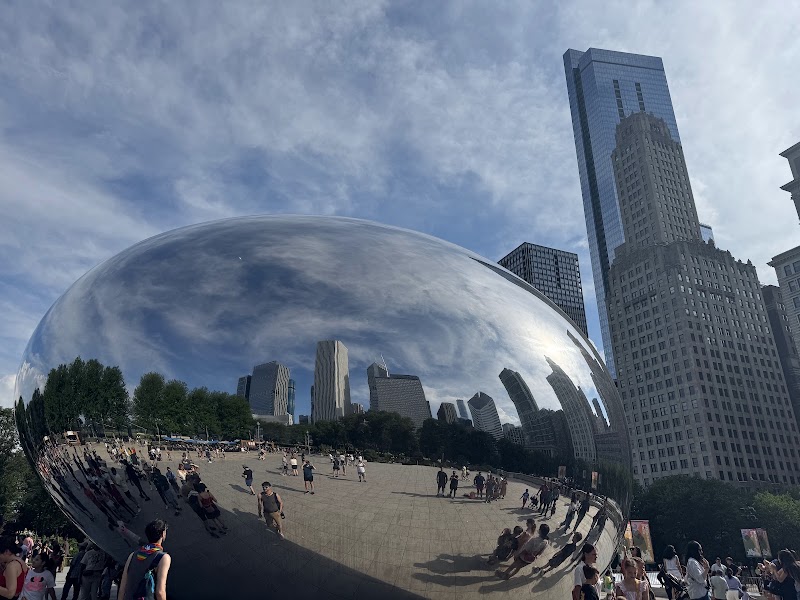
- Cloud Gate — Anish Kapoor’s ellipse of 168 welded stainless steel plates, 33 by 66 by 42 feet and 110 short tons, polished until the seams vanish. Visitors walk under a twelve-foot arch into the concave chamber Kapoor called the omphalos. It was his first public work in the United States, budgeted at $6 million, delivered for about $23 million, and formally dedicated on May 15, 2006 — though Chicago had already renamed it “The Bean.”
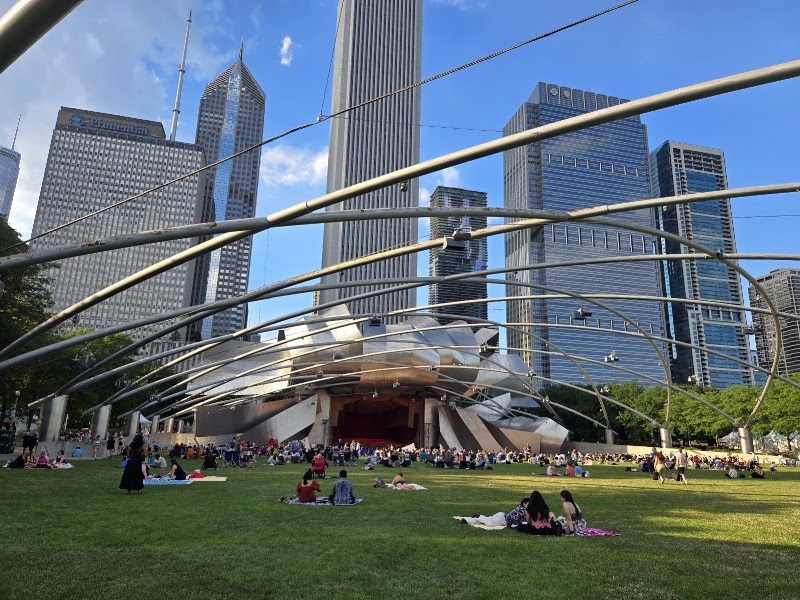
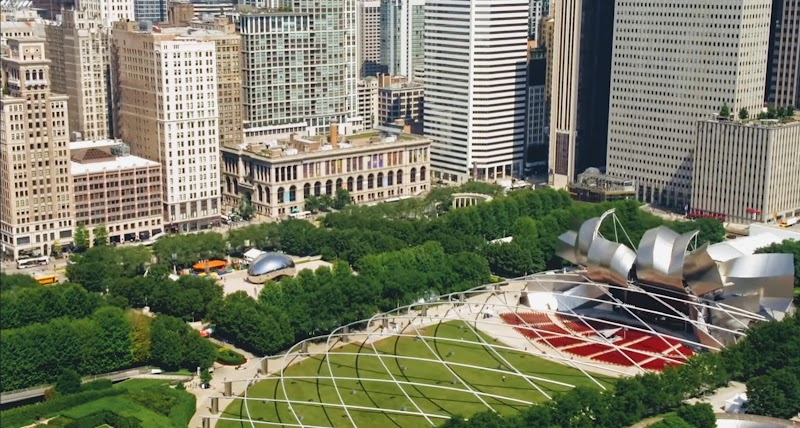
- Jay Pritzker Pavilion — Frank Gehry’s bandshell of billowing stainless ribbons, 139 feet at its peak, seating 4,000 with lawn room for 7,000 more. A steel trellis arcs over the whole lawn carrying a distributed sound system designed to give open-air listeners the acoustics of an indoor hall. Costs rose from $10.8 million to $60.3 million.
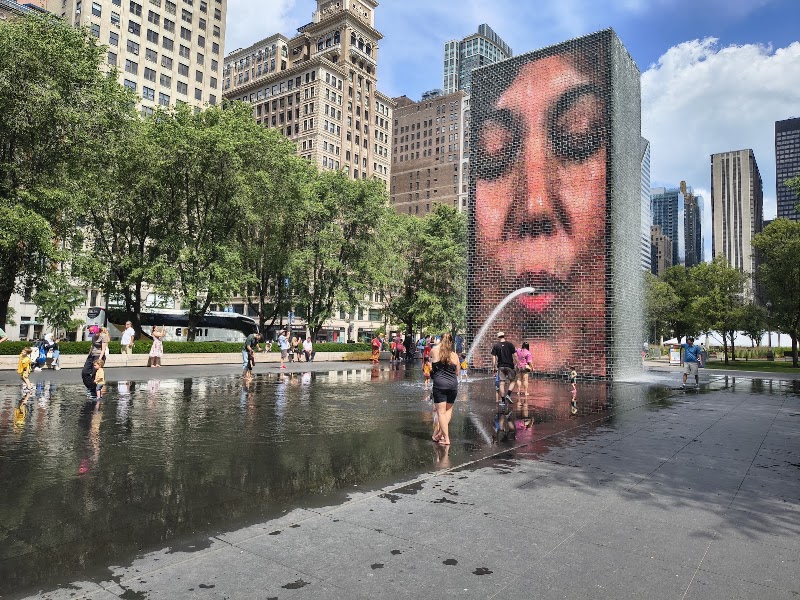
- Crown Fountain — Jaume Plensa’s pair of 50-foot glass-block towers, faced with LED screens showing the portraits of roughly 1,000 ordinary Chicagoans. Each face eventually purses its lips and a jet of water arcs out onto the black granite film below, a modern reading of the old gargoyle.
- Lurie Garden — 2.5 acres by Kathryn Gustafson, Dutch plantsman Piet Oudolf and designer Robert Israel: 240 perennial varieties, roughly 60 percent Illinois natives, split into a shaded Dark Plate for the city’s marshy past and a sunlit Light Plate for its future. A 15-foot armature hedge, the Shoulder Hedge, salutes Carl Sandburg’s City of the Big Shoulders.
- BP Bridge — Gehry’s first bridge, 935 feet of brushed steel scales winding over traffic to Maggie Daley Park. It doubles as an acoustic barrier for the pavilion behind it, and its five percent grade makes it step-free end to end.
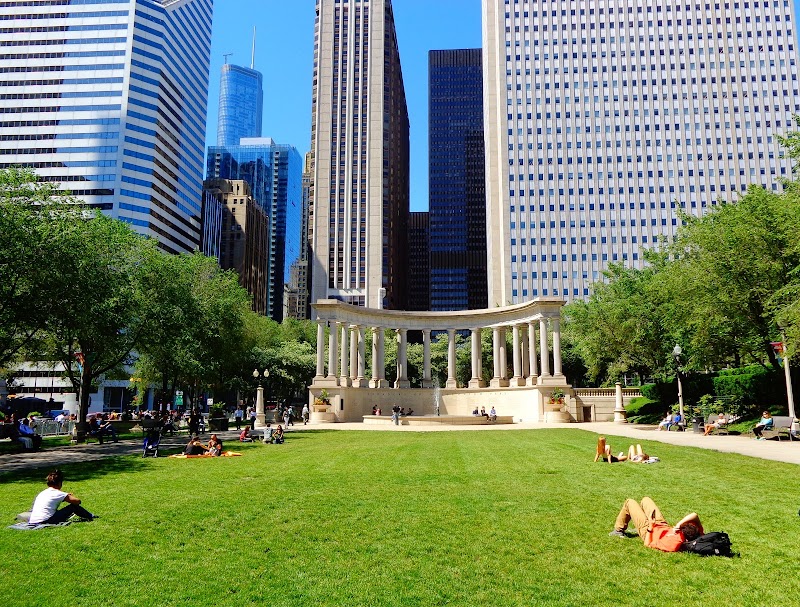
- Millennium Monument — a near-full-scale limestone peristyle on Wrigley Square, rebuilt in tribute to the Doric colonnade that stood on this ground from 1917 until 1953.
What you’ll find
Beyond the famous set pieces the park hides an entire cultural campus, much of it driven underground to respect the century-old ban on tall buildings anywhere in Grant Park.
- The Joan W. and Irving B. Harris Theater for Music and Dance, 1,525 seats built almost entirely below grade for small and mid-sized companies.
- McCormick Tribune Plaza, the first piece of the park to open in December 2001: an ice rink from mid-November to mid-March and an open-air dining terrace in summer.
- Four Exelon Pavilions — two by Thomas Beeby, two by Renzo Piano — that generate solar power, hold the welcome center and disguise the garage entrances.
- The Nichols Bridgeway, Renzo Piano’s slender span opened in May 2009, lifting walkers from the Great Lawn to the third floor of the Art Institute’s Modern Wing.
- The Boeing Galleries, two outdoor rooms added in 2005 for rotating contemporary sculpture, and the eight-acre Chase Promenade used for festivals.
- The McDonald’s Cycle Center, a 300-space bicycle station with showers, lockers and on-site repair.
Things to do — and who it’s for
- First-time visitors — the classic circuit from the peristyle to Cloud Gate, across the pavilion lawn and over the bridge takes roughly an hour on foot and covers every landmark.
- Families with children — Crown Fountain’s shallow black granite pad is the best free water play in the city from May through October, and there is no admission or ticket of any kind.
- Music lovers — the Grant Park Music Festival, running since 1931 and the country’s only remaining free, municipally supported outdoor classical series, occupies the pavilion for ten weeks each summer.
- Photographers — the omphalos under Cloud Gate multiplies and inverts the skyline; early morning light and the hour after sunset give the cleanest reflections.
- Gardeners and naturalists — Lurie Garden peaks twice, once in the June salvia flood and again in September and October when Oudolf’s grasses and seed heads take over.
- Skaters — more than 100,000 people use the plaza rink each winter; skate rental is on site and the ice is free to use.
Getting there & practical
The park occupies the northeast corner of the Loop, so almost every ‘L’ line lands within a short walk. Elevated Brown, Green, Orange, Pink and Purple trains stop at Washington/Wabash; the Red Line subway stops at Lake and the Blue Line at Washington. Metra Electric and South Shore trains arrive directly beneath the park at Millennium Station, which connects into the downtown pedway — useful in January. Entry to the park, all of its artworks and every festival concert is free; the Harris Theater and the neighboring museums sell their own tickets separately. Gates are open daily from 6 a.m. to 11 p.m. Allow two hours for a first pass, or half a day if you add the garden and an evening concert.
When to visit
Summer is the park at full volume: the fountain running, free classical, jazz and world-music nights on the lawn, film screenings after dark, and Cloud Gate ringed with visitors until closing. Spring is quieter and underrated — Lurie Garden’s river of blue salvia opens in June, and weekday mornings before the tour buses are nearly private. Autumn may be the finest season of all, when Oudolf’s grasses turn copper and bronze and low light rakes across the steel. Winter empties the plazas, fills the rink with skaters, and leaves Cloud Gate mirroring a bare silver skyline — with the lake wind that made Chicago’s reputation.
Good to know
All of this was open water until the Illinois Central Railroad built out the shoreline in the 1850s, and for the next century and a half the site stayed a working rail yard and surface parking — the last raw scar on Chicago’s front yard. Mayor Richard M. Daley launched the project in October 1997 as a modest $150 million deck over the tracks, with a Beaux-Arts master plan by Skidmore, Owings & Merrill; construction began in 1998. Then the donors arrived. The Millennium Park Foundation, founded in 1998, raised roughly $220 million in private money, and with it came Gehry, Kapoor, Plensa and Gustafson — every one of them a late addition to a plan that had contained none of them. The final bill reached about $475 million, and the opening slipped four years past the millennium the park was named for. One legal quirk shaped the whole design: because Aaron Montgomery Ward’s Illinois Supreme Court victories forbid buildings in Grant Park, the pavilion had to be classified as a work of art rather than a structure, and the Harris Theater was buried underground. Attendance grew from 3 million in the first year to around 25 million by 2017.
Visitor tips
- Come before 8 a.m. if you want a photograph of Cloud Gate with nobody in it — on weekday mornings the plaza is close to empty, and crews are usually still polishing the lower seams.
- Bring a blanket for the Pritzker lawn rather than chasing a fixed seat: the trellis speakers give lawn listeners the same balanced sound, and lawn space is free and first-come.
- Enter Lurie Garden from the boardwalk side and walk the Seam slowly — the shallow water channel there traces the nineteenth-century seawall and is the coolest spot in the park in August.
Questions & answers
Is Millennium Park free? Entirely. The park, Cloud Gate, Crown Fountain, Lurie Garden and the Grant Park Music Festival concerts all cost nothing. Only the Harris Theater and the nearby museums charge.
What is “The Bean” actually called? Cloud Gate. Anish Kapoor disliked the nickname for years and said so publicly, but Chicago never gave it up and the city now uses both.
Can you touch Cloud Gate? Yes, and everyone does. Maintenance crews wipe the lower plates almost daily and give the whole surface a deeper polish twice a year.
When does Crown Fountain run? Roughly May through October, weather permitting. The video portraits keep playing year-round even when the water is shut off for frost.
How long should I plan? Ninety minutes covers the highlights. Three to four hours lets you add Lurie Garden, the BP Bridge and a concert on the lawn.
Is it separate from Grant Park? Technically no. Millennium Park is a 24.5-acre section in Grant Park’s northwest corner, operated by the city’s cultural affairs department rather than the park district.
Why is so much of it underground? Court rulings won by Aaron Montgomery Ward between 1897 and 1910 bar buildings in Grant Park, so the theater, the parking and the mechanical plant all went below grade.
Photos
Show 1 more photos
Visitor reviews
Reviews last updated: 2026-08-04 16:02:02
Data is refreshed monthly. Sources: chicagoname.com and editorial picks based on reviews.
A very nice place for tourists, the photos will stay with you, and so will the impressions
A little piece of coziness, calm and rest in a green place.
It's worth visiting with family, with kids.
It's good when a big city has green areas like this. It doesn't matter whether everything is done perfectly, what ma…
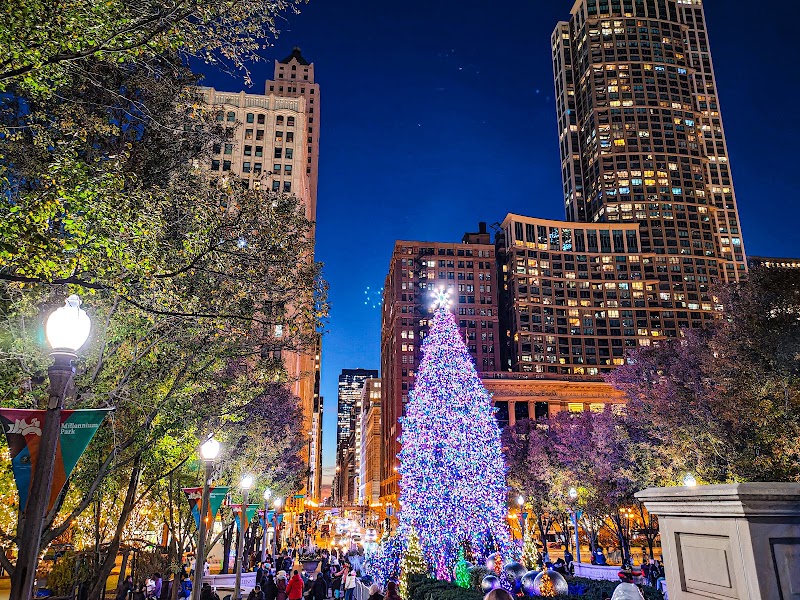
Nice Christmas tree. Didn't like the Bean.
Closed. Under renovation. And there's no information on the maps.