

Park · Chicago · ⭐ 9.5/10 · 8619 reviews · updated: 2026-08-04 16:02:04
Address: 337 E Randolph St, Chicago, IL 60601, United States
Maggie Daley Park — downtown Chicago’s playground built on a rooftop
Rolling hills, groves and winding paths fill the northeast corner of Grant Park, and almost none of it rests on natural ground. The entire park is a roof: it sits on the deck of a parking garage holding some four thousand cars, in the middle of the Loop, with every hill, tree pit and skating surface engineered into a structure that was never meant to carry a landscape. Michael Van Valkenburgh Associates organized it along two diagonal axes and designed it as a sequence of small worlds rather than one open lawn, with soil engineering and heavy native planting that cools the site and lets it absorb a hundred-year storm. Skaters arrived in December 2014; children took possession the following spring.
Highlights
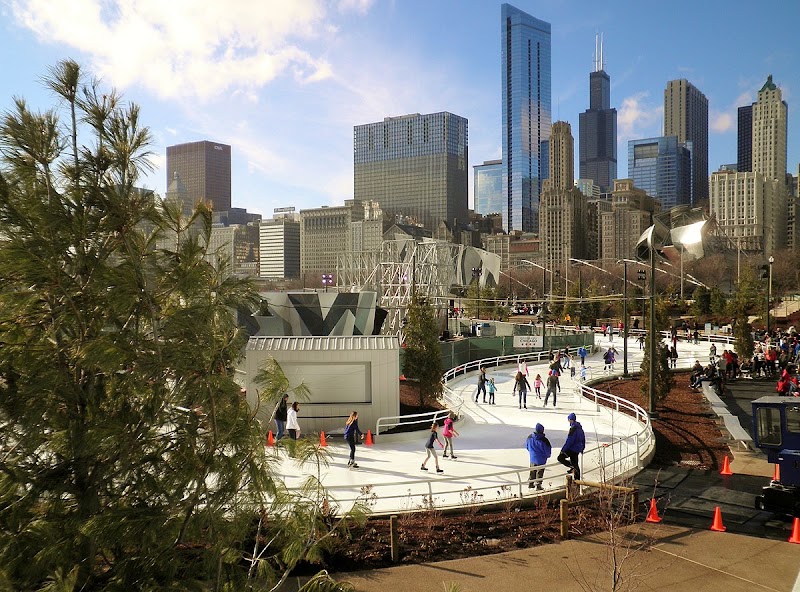
- The Skating Ribbon — a quarter-mile ice track that curls around a rock outcrop instead of circling a rink. It runs about twice the length of a conventional rink and holds more than 700 skaters at once, and its winding form echoes the Gehry bridge that lands nearby.
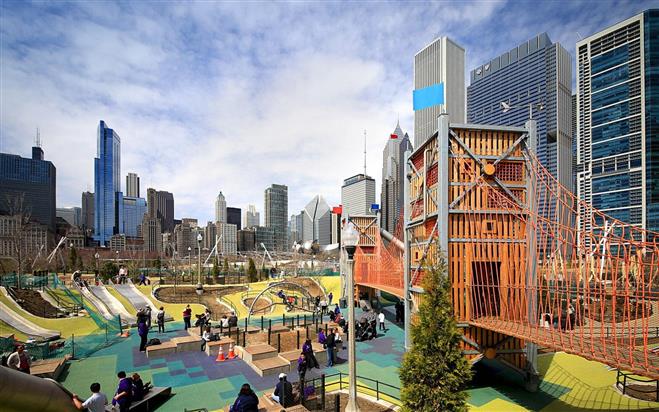
- The Play Garden — three acres divided into six themed zones, each with its own scale, surface and age range: the Wave Lawn, the Harbor, the Watering Hole, the Slide Crater, the Enchanted Forest and the Sea.
- The Climbing Walls — two sculpted formations rising close to 40 feet, forming the only climbing park operated by the Chicago Park District, with staff belaying and gear on site.
- The mini golf course — eighteen holes routed through the park’s engineered berms and plantings rather than laid across a flat pad, so the course climbs and drops with the topography.
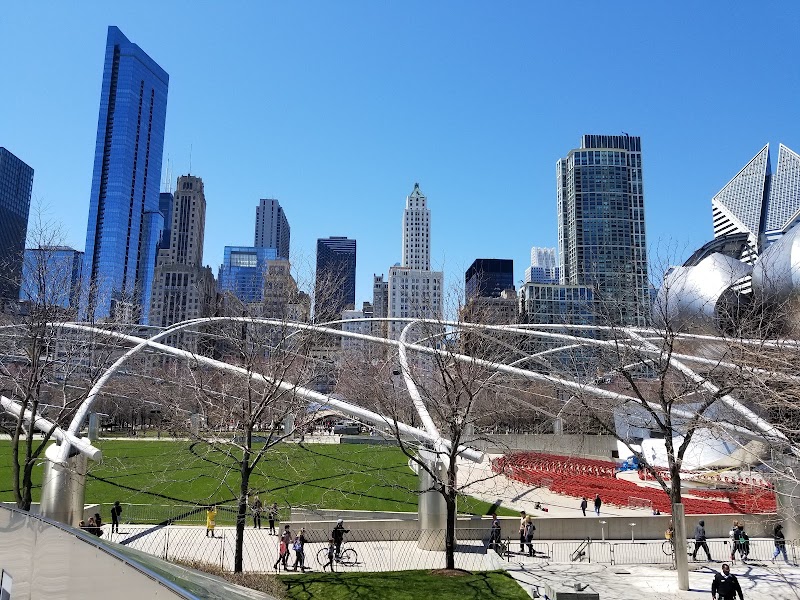
- The BP Pedestrian Bridge — Frank Gehry’s serpentine stainless-steel span, opened in 2004, carrying walkers over the roadway from Millennium Park and delivering them straight into the trees.
- The Richard and Annette Bloch Cancer Survivors Garden — a terraced garden with a colonnade and lake outlook, inherited from the plaza that stood here before and kept through the rebuild.
What you’ll find
The park reveals itself in pieces. Sightlines are deliberately short, hills block the traffic below, and each lobe attracts a different crowd — toddlers in one hollow, climbers on the ridge, office workers on the lawns.
- A field house designed by the Chicago studio Valerio Dewalt Train, holding skate rental, changing rooms, restrooms and a café.
- Six tennis courts and pickleball courts on the park’s western lobe, rebuilt to replace those lost with the old plaza.
- The Wave Lawn, a set of graded green slopes made for lawn games, picnics and rolling downhill, open to every age.
- The Enchanted Forest, roughly 3,590 square feet of pathways under archways of inverted trees, with a Turning Stone that pivots on its axis and the Kaleidoscope mirror maze.
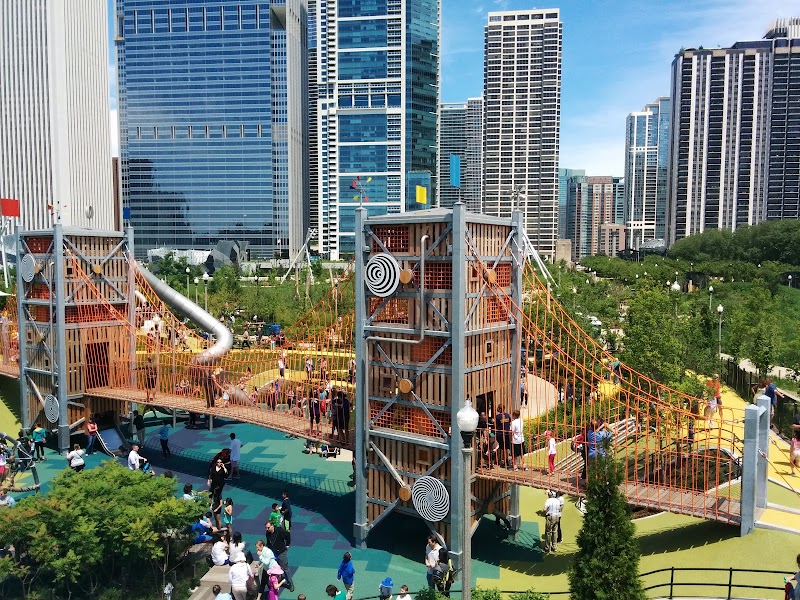
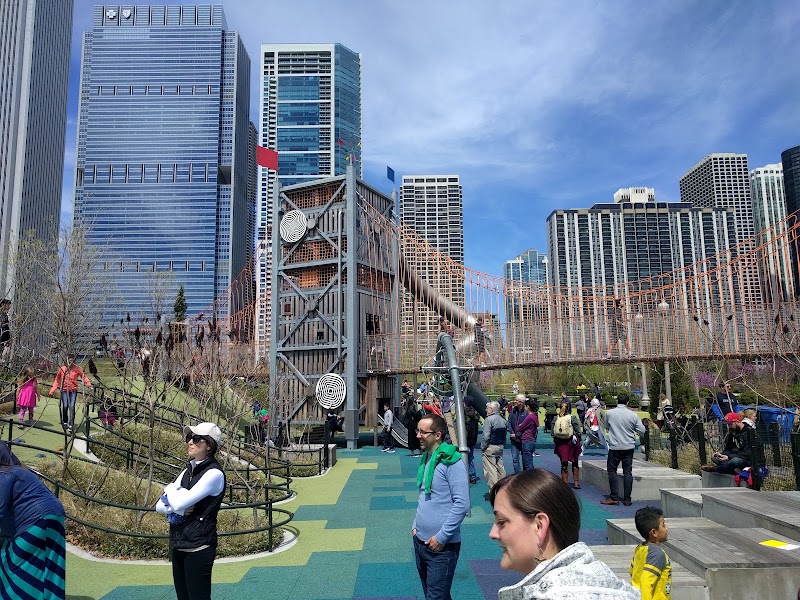
- The Slide Crater, about 12,000 square feet, entered from above by the Tower Bridge — a suspension walkway between two towers, one carrying slides, the other knobs, flags, a viewing scope and talk tubes.
- Thousands of trees, shrubs and perennials set into artificial hills, with lighting tuned to spread a soft glow rather than flood the ground.
Things to do — and who it’s for
- Families with toddlers — the Watering Hole and the Harbor are built for ages two to five, low, enclosed and easy to supervise from a bench.
- Older children — the Sea is an 8,500-square-foot play loop for ages five to twelve, with a large metal play ship, and the Slide Crater takes the same age group.
- Beginner climbers — the walls are staff-belayed and sized for a first attempt, which makes this a rare place to try roped climbing outdoors without a club membership.
- Downtown workers — the ribbon path, benches and lawns turn a lunch hour into an actual break, minutes from the office towers.
- Winter visitors — skating with the skyline directly overhead is the park’s signature experience and the reason the ribbon draws national attention each November.
- Photographers — the bridge, the ribbon and the tower backdrop line up into the classic downtown frame, best worked at dusk.
Getting there & practical
The park stands in the New Eastside district at the edge of the Loop, wedged between the office towers and the lakefront, and it is genuinely a walk-in park — most visitors arrive on foot or by train. Millennium Station, the downtown terminus of the Metra Electric District and the South Shore Line, is the closest rail arrival; the Washington/Wabash and State/Lake ‘L’ stations sit a few minutes west and put you on the far side of Millennium Park, from which the BP Pedestrian Bridge brings you in over the traffic. Entry to the park, the Play Garden, the lawns and the gardens is free, and admission to the skating ribbon is free as well, though skate rental is charged. The climbing walls and mini golf are ticketed separately and operate seasonally, with rental and climbing hours posted daily. The grounds are open from early morning until late evening every day, while the attractions keep shorter schedules and close in bad weather. Allow an hour for a walk-through, two hours if you skate, and half a day if children are with you — the Play Garden is the kind of place families fail to leave on schedule.
When to visit
Winter is the park at its most distinctive. The ribbon typically freezes from mid-November into March — the 2024-25 season opened on November 15, its tenth winter — and the skyline lights make evening sessions worth the cold; weekday nights are far easier than weekend afternoons. Spring wakes the Play Garden and brings the first flowering on the planted slopes, and these are usually the quietest weeks of the year here, before the tourist season starts. Summer is the peak: climbing walls, mini golf, tennis and long evenings, with the lawns crowded at weekends and the whole park calm before mid-morning. Autumn is the connoisseur’s season — warm color across the berms, comfortable air, thinner crowds, and the ribbon reopening just as the trees turn.
Good to know
The site was Daley Bicentennial Plaza, opened in 1976 above the underground garage as a flat, conventional deck park. By the late 2000s the waterproofing membrane over the garage had failed and had to be replaced, which meant demolishing everything on top of it — an expensive obligation the city chose to turn into an opportunity. Michael Van Valkenburgh Associates won the commission, construction ran from 2012 to 2015, and the roughly $60 million project drew largely on the garage’s own revenues rather than on park taxes. The field house came from Valerio Dewalt Train, and the tennis courts were rebuilt on the park’s western lobe. The park honors Maggie Daley (1943-2011), Chicago’s first lady through the long mayoralty of her husband Richard M. Daley and the founder of After School Matters, the program that gives Chicago teenagers paid apprenticeships in the arts and other fields; she died of cancer in November 2011, and the renaming followed. The ribbon was cut on December 13, 2014, and the Play Garden opened the following spring. Because the whole park is a roof, nothing here is accidental: soil depth is calculated area by area, the visible hills conceal lightweight structural forms that transfer their loads to the garage columns below, and the planting is chosen both to survive shallow engineered soil and to cut the heat that a downtown deck would otherwise radiate.
Visitor tips
- Bring your own skates if you have them. Rental lines are longest on winter weekends and holiday afternoons, and the ribbon itself is rarely the bottleneck.
- With small children, enter the Play Garden from the western side — the toddler zones, the Watering Hole and the Harbor, sit closest to that end, so you avoid crossing the older kids’ territory twice.
- Cross the BP Pedestrian Bridge to Millennium Park and treat the two as one outing; the bridge is a Gehry work in its own right and gives the best overhead view back across the park.
Questions & answers
Is Maggie Daley Park free? Yes. The grounds, the Play Garden, the lawns, the gardens and admission to the skating ribbon are all free. Only skate rental, the climbing walls and mini golf carry a charge.
When did the park open? The skating ribbon was inaugurated on December 13, 2014, and the Play Garden opened in spring 2015, after roughly two years of construction that ran from 2012.
How long is the skating ribbon? About a quarter of a mile — roughly twice the skating length of a conventional rink. It loops rather than circles, so it feels like following a winding trail, and it can hold over 700 skaters at once.
Can adults use the climbing walls? Yes. The two walls, close to 40 feet high, are open to adults and children through the warm season, with staff supervision and equipment available on site; this is the Park District’s only climbing park.
Is the park connected to Millennium Park? Directly, by Frank Gehry’s BP Pedestrian Bridge of 2004, which crosses the roadway and lands inside Maggie Daley Park. Most visitors walk the two parks as a single trip.
Who was Maggie Daley? Chicago’s first lady from 1989 to 2011, wife of Mayor Richard M. Daley and founder of After School Matters, the city’s teen arts and jobs program. The park was renamed in her memory after her death from cancer in November 2011.
Photos
Show 1 more photos
Visitor reviews
Reviews last updated: 2026-08-04 16:02:04
Data is refreshed monthly. Sources: chicagoname.com and editorial picks based on reviews.
An incredible and enormous park with tons of fun playgrounds and slides for kids of all ages. Check spothero for cheap and convenient parking, but you'll have to walk a bit.
One of the best playgrounds I've ever seen. It's huge, very well designed and has so many interesting areas for kids. A great place for a family outing, and the park itself is lovely too.
Maggie Daley children's play park is the most amazing playground you could imagine. I'm a grandmother and I walked through it for exercise; what a joy it is to see kids running, climbing, sliding, swinging and discoverin…
Uma delícia para passear. Também tem vista para o lago Michigan em alguns trechos. Fomos em Abril e gostamos bastante de passear por lá.
Maggie Daley Park, a 20-acre recreational marvel in Chicago's Grant Park, is a testament to the transformative $60 million investment that revived the former Daley Bicentennial Plaza. Opened between 2014 and 2015, this p…