

The history of Chicago is marked by the names of many renowned scientists, scholars, and developers whose work and talent transformed a small town into a global metropolis. The growth of Chicago’s infrastructure is inextricably linked to the name of engineer Fazlur Rahman Khan. He is, notably, one of the creators behind the design of the Willis Tower skyscraper, as reported by “chicagoname.”
Early Life and Education
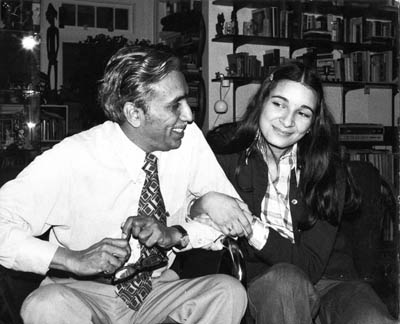
The future “father of skyscrapers” was born on April 3, 1929, in Dhaka, which was then part of British India. From childhood, the inquisitive boy was interested in the hard sciences, as his father was a math teacher and a major authority figure in his life.
Fazlur Rahman Khan began his higher education at the Bengal Engineering College in the Department of Civil Engineering. The young man showed remarkable academic success, which allowed him to receive a scholarship to the University of Illinois in the United States.
After moving to the States, Fazlur Rahman Khan earned two advanced degrees: a master’s degree in structural engineering in 1953, followed by a Ph.D. in the same field a few years later. While studying at the University of Illinois, he focused on mastering computer calculations in the development of engineering projects and on modern construction methods.
The Start of an Engineering Career
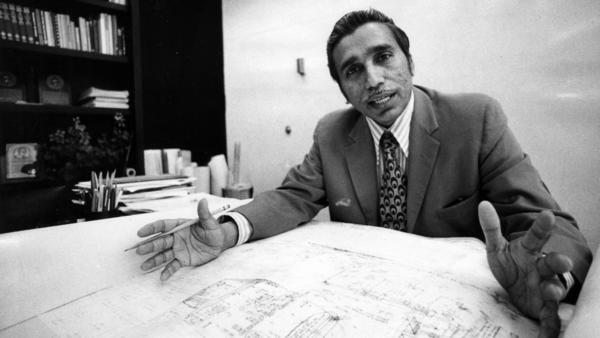
The talented student’s dedication did not go unnoticed, and immediately after graduation, Fazlur Rahman Khan was invited to work for the famous Chicago architectural firm, Skidmore, Owings & Merrill (SOM). By 1966, the academic achieved partner status in the company, and later became a general director, thanks to his successful development of methods for the efficient use of building materials.
The first building where Khan tested his developed methods was the high-rise Chestnut De-Witt. In the early 1970s, the talented engineer’s name became known far beyond Chicago due to the realization of projects like the 100-story John Hancock Center and the 110-story Willis Tower (formerly Sears Tower), which was, at one time, considered the tallest building in the world.
In his own work, Fazlur Rahman Khan adhered to one fundamental principle: he believed that engineers should look at life through a much broader lens. People with an engineering education shouldn’t immerse themselves solely in work, as life also includes drama, people, music, and much more.
When developing projects, the engineer’s primary concern was ensuring the building was comfortable for people. Fazlur Rahman Khan cared about how his engineering developments affected people. He wanted every building he designed to become an inseparable part of society and cultural life.
Most Famous Innovations

The most productive period in the architect’s career was the 1960s and 1970s. It was during this time that Fazlur Rahman Khan developed structural systems that allowed for the construction of skyscrapers with stable and economical designs. The Chicago engineer’s cutting-edge method completely transformed the system of high-rise construction.
One of Fazlur Rahman Khan’s first discoveries was the tubular construction system. Before this innovative development, the vast majority of buildings in Chicago were constructed using the frame method, where the entire load was evenly distributed between the interior and exterior walls. This often led to unnecessary material waste.
Instead, Khan developed a tubular system where the load was carried by the exterior walls, which consisted of columns and beams. This innovation allowed for the construction of significantly taller buildings and nearly halved the budget for materials. A prime example using the tubular system is the DeWitt-Chestnut Apartment Building, constructed in 1965.
The idea of tubular structures was also adopted for the construction of the twin towers of the World Trade Center in New York. The engineer continued to work on improving his methods and later helped complete the 100-story John Hancock Center.
The project was the world’s first multi-functional skyscraper, featuring numerous restaurants, offices, and at least seven hundred condominiums. To increase the building’s safety and protection against earthquakes, Khan additionally incorporated special truss bracing.
Fazlur Rahman Khan also worked on reinforcing the tubular structure. The engineer believed that the standard system would deform over time due to wind influence. The inventor proposed reinforcing the tubular structure with special diagonal supports. This resulted in increased building stability. Furthermore, these changes offered the opportunity to experiment with architectural design and transform each building into a unique structure. Based on the reinforced tubular design, the 100-story John Hancock Center was built in Chicago in 1969.
The idea for a structural system for large roofs is also credited to Fazlur Rahman Khan. The engineer designed modern, lightweight structures to cover large areas. The “light roof” was used during the construction of the King Abdulaziz International Airport, considered the world’s largest terminal.
One of Khan’s most important inventions is the “bundled tube” concept. To reduce costs, the engineer proposed combining several tubes into a single structure. This method was used during the construction of the Willis Tower in 1973.
Awards and Final Years
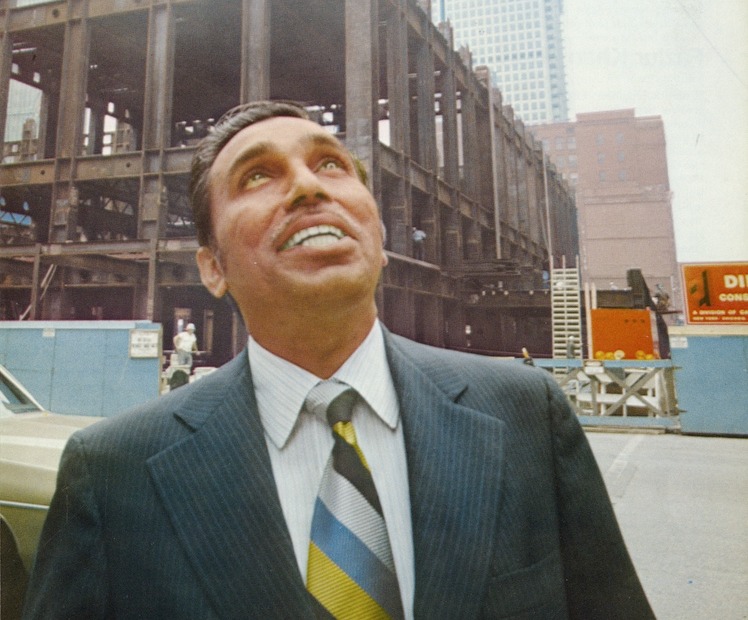
During his work, Fazlur Rahman Khan adhered not only to standard engineering principles but also had his own vision for its development. He believed that engineering was inextricably linked to architecture, and that new technologies should be used exclusively for the benefit of society.
Working at the University of Chicago, Fazlur Rahman Khan consistently supported young engineers and helped them master his ideas and developments. Throughout his life, he received numerous prestigious awards, including the Thomas Jefferson Medal and the William Proctor Medal for his innovative approach and contribution to construction, and the AIA Gold Medal (American Institute of Architects) for his outstanding contribution to the art of high-rise reinforced concrete construction.
The engineer’s heart stopped on March 27, 1982. The cause of death was a heart attack; he was only 52 years old.
The Engineer’s Contribution to Construction and Architecture

Fazlur Rahman Khan’s innovative ideas were widely adopted for skyscraper construction around the world, fundamentally changing the approach to high-rise design. Specifically, the engineer’s methods were applied during the construction of the Burj Khalifa in Dubai.
The main advantages of Khan’s ideas were:
- New opportunities for architects, who gained greater freedom for skyscraper design.
- A substantial reduction in production costs, as the new structural systems allowed for less material to be used in construction.
- Resistance to seismic activity. The structures developed by Fazlur Rahman Khan demonstrated excellent performance in countries with high levels of seismic activity.
His talent and innovative developments opened many doors and opportunities for Khan, yet he remained loyal to a single company, Skidmore, Owings & Merrill, for virtually his entire career.
Khan’s methods are still used in high-rise construction today. Thanks to his developments, the talented engineer is forever remembered as the “father of the modern skyscraper.”